


September is Life Insurance Awareness Month. We love a theme here at Covr. As such, we have chosen to train our lens on a wealth preservation strategy called “Buy, Borrow, Die.” Specifically, we aim to focus on the “Buy” portion of the strategy because of recent economic events. Namely, the crossing of the $40 trillion threshold in federal debt that now lives in our collective rearview like a deer smashed to bits of fur by a speeding Peterbuilt.
What does one have to do with the other? And what does any of this have to do with life insurance?
Hunker down. I’ll try to make this as brief and concise as possible.
What is “Buy. Borrow, Die”?
Let me oversimplify “Buy, Borrow, Die.” It’s a wealth preservation strategy that attempts to control tax drag on assets and it works like this: A person buys an appreciating asset, like a home or privately-owned business, and borrows against it, rather than liquidating it in order to avoid a taxable event. At death, the asset gets passed on to heirs whilst enjoying a step up in basis, further limiting the tax drag.
$40 Trillion Changes the Equation
It is notable that we crossed the $40 trillion mark simply because it is a mind-numbing figure, and because the speed with which we’re accumulating debt seems to be increasing, AND the interest expenses are now greater than national defense spending on some relevant budget measures. The enormous amount of Treasury debt being issued, along with concerns about inflation and fiscal sustainability, are putting upward pressure on Treasury yields, and could eventually squeeze both the “Borrow” and “Die” portions of the aforementioned wealth preservation strategy.
The reason is that Treasury yields underpin debt markets and may eventually drive higher lending rates in other parts of the economy. Think mortgages, car loans, etc. As these costs rise, the BBD strategy becomes less attractive and less economically efficient.
What Happens When the “Die” Assumption Changes?
As far as the “Die” portion of the strategy goes, one has to figure that our appetite for continuing to grow this debt at this pace may reach its limit. At that point, policymakers have a few tools at their disposal: reduce spending, raise revenue (taxes), and/or pursue tighter monetary policy. If and when any of these measures are taken, how will inflation respond? And how could any of this future legislation impact important tenets this strategy depends on, namely the step up in basis? The Biden administration famously proposed ending this tax benefit as a way of growing SOME tax revenue. And it has come up before and may come up again.
A Different Approach to the “Borrow” Portion
Leveraging cash-value life insurance in the ‘Buy’ portion of this strategy CAN offer a way to reduce reliance on some of the assumptions underlying the ‘Borrow’ and ‘Die’ portions of the strategy like this: Overfunding (a non-mec) policy, then borrowing against it means that the cost to borrow may be lower than doing the same thing with equities.
The reason for this is that loans against insurance policies sometimes carry lower interest rates. Plus, the loan itself may not negatively impact the accumulating power of the policy. This is a way to manage the borrowing costs, and retain some level of efficiency.
Rethinking the “Die” Portion
On the ‘Die’ portion of the strategy, death benefits, if the policy is properly owned by an irrevocable trust and structured so that the insured retains no incidents of ownership, generally will not be included in the insured’s gross estate. Those proceeds, net of any loans, pass to heirs income-tax free, bypassing the need for a step up in basis. That’s been established law for a long time and seems fairly safe going forward.
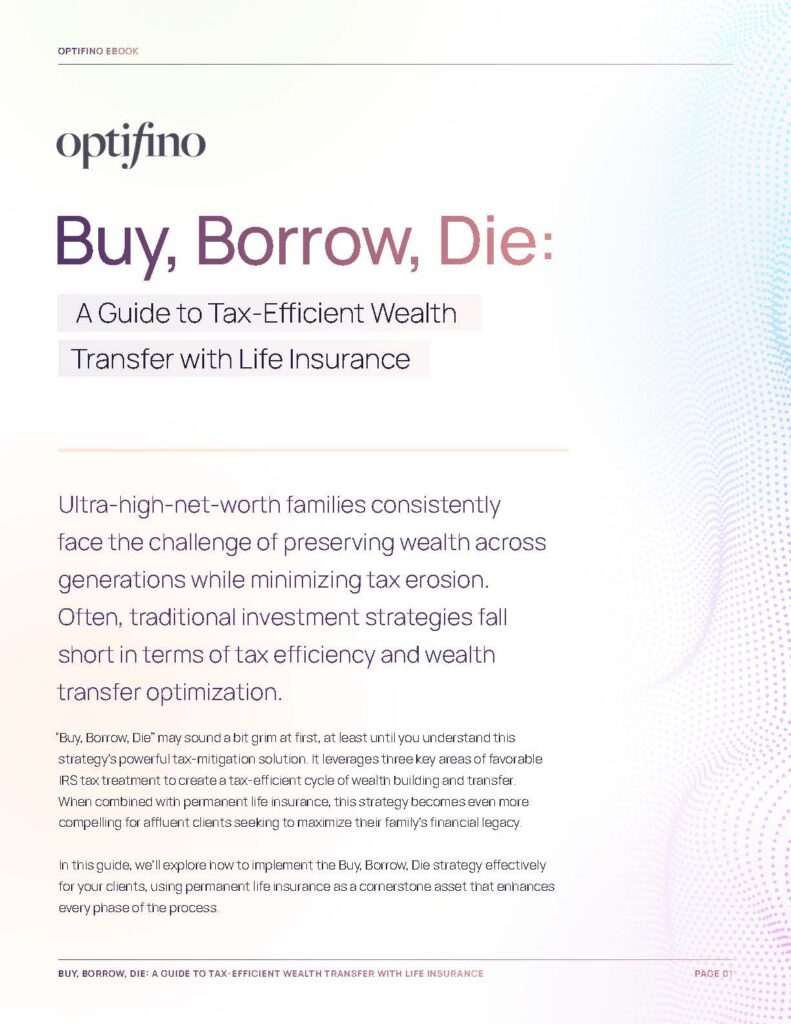
Want to dive deeper into BBD?
This can be a complex strategy, and as I am not a tax expert I don’t pretend to dispense with tax advice. Please consult with a tax advisor before implementing a BBD strategy with your clients. Also, know that borrowing against a cash-value life insurance policy can trigger a lapse if not managed and designed properly. Again, consult with experts before trying to go this alone.
Download the “Buy, Borrow, Die” ebook →